David Gessel
3 capitals
Interesting bit of trivia, @phragments, how one can drive through the three capitals: but one only takes 90 seconds…
— Sent from my mobile device
made it to DC
It was a fun weekend with the Westtown gang.
A week of tweets: 2010-05-09
- Wow, that’s 4 police cars going west on lincoln code red #
- Facebook IPs? First reported on Dec 28 (that I see). But fun to play with #
- At my 25th high school reunion at Westtown School. #
Powered by Twitter Tools
this took less than 10 minutes
The “like” button got added about 10 minutes ago.
I guess people have some issues with facebook, or get the irony. Either way pretty cool that 495 people liked it in the first 10 minutes. And that’s from 2 of 8 servers (meaning 75% of visitors don’t see it yet).
I like that.

TOR blocked on Acela
The Acela uses a Barracuda Networks filter to prevent people from looking at things they shouldn’t look at on the train, blocking video and large file downloads and generally drawing a draconian moralistic screen in front of the internet.
Given that TOR was invented by the Navy and is embraced by the state department, it seems a bit much to block access to the HOME PAGE.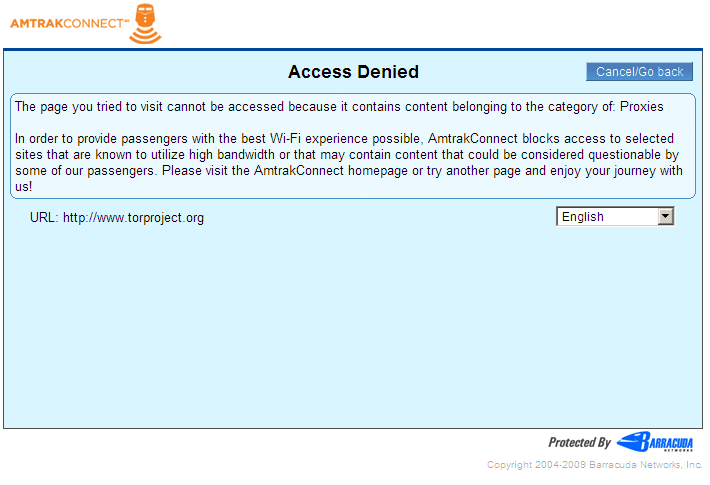
And don’t visit the Mozilla search page – you might “download” something!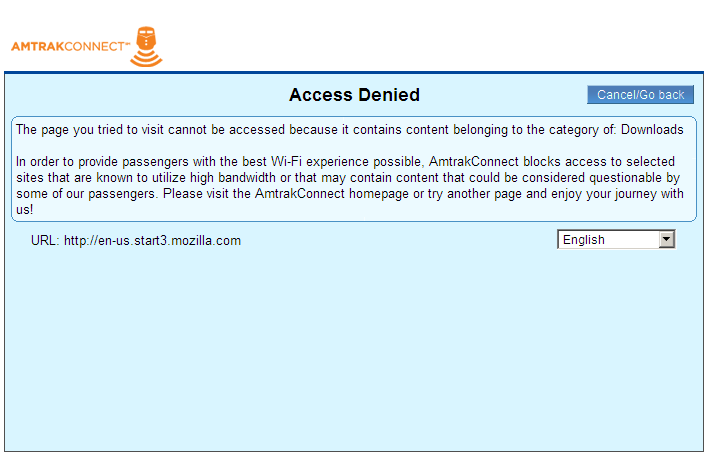
And WTF? dis.org sponsors criminal activity? I wonder if this has more to do with retaliating against Pete’s patent on reactive firewalls that Barracuda is probably infringing than preventing train users from getting access to Yasu user manuals from the late 90s.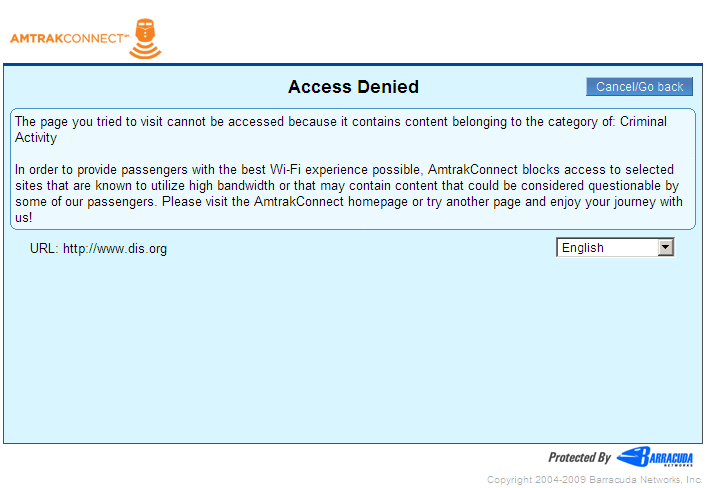
Yay censorship! I really want some faceless cadre of morons dictating what information is good for me. No bad can possibly come of that.
flatus
There’s somebody near me on this plane who has atomic farts. I mean wake you up with burning eyes from a deep, oxygen deprived, alcohol enhanced sleep coughing farts. Farts like I’ve never had the misfortune to experience before.
All the more amazing because plane ventilation systems normally draw air in around your feet and spray fresh air out above you, so the flow tends to suck the farts out before have to smell them, along with stinky feet and other body odors. But somehow these farts are fighting upstream and arriving still potent and fresh.
And it isn’t just a single fart, but fast and furious. You’re just getting over the last one and starting to nose-breathe again when the next one hits. I think the guy next to me suspects they’re coming out of my ass. Each time one wafts by he covers his nose with his shirt (hard to do with an oxford, but desperate times…) and glances my way. At what point, sitting next to someone on a plane, do you say “who cut that cheese?” Does the admission that you smelt it imply delt it?
Maybe I should very obviously let one fly in a olfactory lull in a testimony of sorts.
the Cloud
On the Media is an excellent resource always, but the second segment of the Apr. 23, 2010 goes over the lack of protection afforded data in the cloud due to the Stored Communications Act, an increasingly important topic.
Current law allows a very low standard for access to “Stored Communication” such as Gmail or Google Docs or any other “cloud service.” It turns out that Google gets about 20 requests for data a day and if an investigator asks for your email they do not need a warrant to get it.
If you don’t own the hardware, you don’t own the data.
Even if the Stored Communications Act is overturned, any data you store on a remote server such as Google’s, is Google’s and not yours. You have no right to get it back, no rights controlling Google’s dissemination of your data or resale thereof. In many cases there is a click through agreement with the service provider which may, for example, state that certain information will be kept private or not sold, but such clauses are typically superseded by statements claiming the right to rewrite the agreement without notification.
For example, FaceBook might change default privacy settings such that information you stored on their server with the understanding that it would be kept private is later exposed to search engines and indexed and thus made public, thereby increasing search traffic to their site, and thus to their advertisers.
FaceBook did not give, and was not required to give any particular notice. The data you put on their servers is theirs, not yours.
Don’t put data in the “cloud” you don’t want to be public. Google Docs is not a replacement for Open Office on your own hardware. Companies don’t make any money offering you free, private compute resources and storage; these services are profitable by exploiting the value of your information. In the long run it is probably cheaper to buy your own hardware.
Side note: in this excellent episode of OTM, they also cover the GAO’s pooping all over the MPAA/RIAA linkage between guerrilla antitrust (unauthorized copying) and economic problems. OTM also points out the linkage between the asinine ruling against the FCC and Net Neutrality, which is a free speech disaster, and worse still the MPAA/RIAA efforts to create a world-wide three-strikes rule to extort money to replace the money they used to be able to generate with their obsolete business model.
Twitter client feature I want
One of the irritations I have with twitter and short form UGC streams is that there are people, the ebb and flow of who’s lives I find interesting, but who feel a compulsion when they attend a conference (say) to update every clever comment they hear.
While, in principal, I might find these comments interesting and appreciate the effort to provide me with a low-bandwidth telepresent experience, but for the most part I’m not attending the conference because it wasn’t a priority for me. And it becomes a bit tedious when my twitter stream is filled start to finish with notes from some random conference I’ve never heard of.
A solution would be for my client to have a feature that rate limits anyone. There are some people I’d only want to see one tweet a day from, though there are a few from whom I’d want to see all of them. It would be nice if other users, those who’s dedication to the medium or the source was unwavering, would rate tweets such that I wouldn’t miss the good ones.
Except for my loved ones, I’d choose to filter all tweets that didn’t get at least one positive vote.
A week of tweets: 2010-04-25
- Wow…. use for an iPad! http://www.wimp.com/catipad/ #
- Mercedes E350! Thanks Hertz! Actually has an ipod interface too! #
- Awesome! beware the cloud: if you don’t own the hardware, you don’t own the data. All big targets will be p0wned #
- brilliant research technique! http://www.xkcd.com/715/ #
- At dorkbot, analee newlitz speaking against immortality. #
Powered by Twitter Tools
Facebook Open Graph Fun

More detailed instructions about how to access facebook’s new Open Graph (below). Open Graph is an interesting OAuth based mechanism by which facebook is opening their database to “select” third parties and allowing those parties to read FB cookies and automatically connect to FB and read “engagement enhancing” information about the user such as their social graph, their profile, their news feed, the groups they belong to, their pictures (including all that they’ve been tagged in): just about everything FB knows about them. The details are at this URL.
It is not 100% clear to me yet whether giving the third party access to the facebook cookies, but if the techcrunch article is correct, then third parties can read FB cookies, which are all under the domain .facebook.com and all “send for: Any type of connection” including the “lxe” cookie which is the user’s sign-in email address.
To experiment with Open Graph, first log in to facebook… Read more…